How Long Does Probate Take in Illinois? A Realistic Timeline
By Long Law Group — Estate Planning and Administration Attorneys Serving Naperville, the Western Suburbs, and Greater Chicagoland.
If you’ve recently lost a loved one in the Naperville or DuPage County area, you may be hearing the word “probate” for the first time — and wondering what it means for your family’s timeline.
The short answer: Illinois probate typically takes 12 to 18 months for a straightforward estate. Complex estates — or those with disputes — can take significantly longer.
Here’s what the process actually looks like, what causes delays, and what you can do to protect your family’s time and resources.
What Is Probate in Illinois?
Probate is the legal process through which a deceased person’s estate is administered under court supervision. It involves:
- Validating the will (if one exists)
- Identifying and inventorying the deceased’s assets
- Notifying and paying creditors
- Filing required tax returns
- Distributing remaining assets to heirs or beneficiaries
In Illinois, probate cases are handled at the county level. For families in the Naperville area, that typically means DuPage County or Will County Probate Court. Chicago-area estates go through Cook County.
Not all estates require full probate. Illinois has a Small Estate Affidavit process for estates under $150,000 (as of August 2025) that can significantly simplify things. But for most estates with real property or significant assets, the full probate process applies.
The Illinois Probate Timeline: Phase by Phase
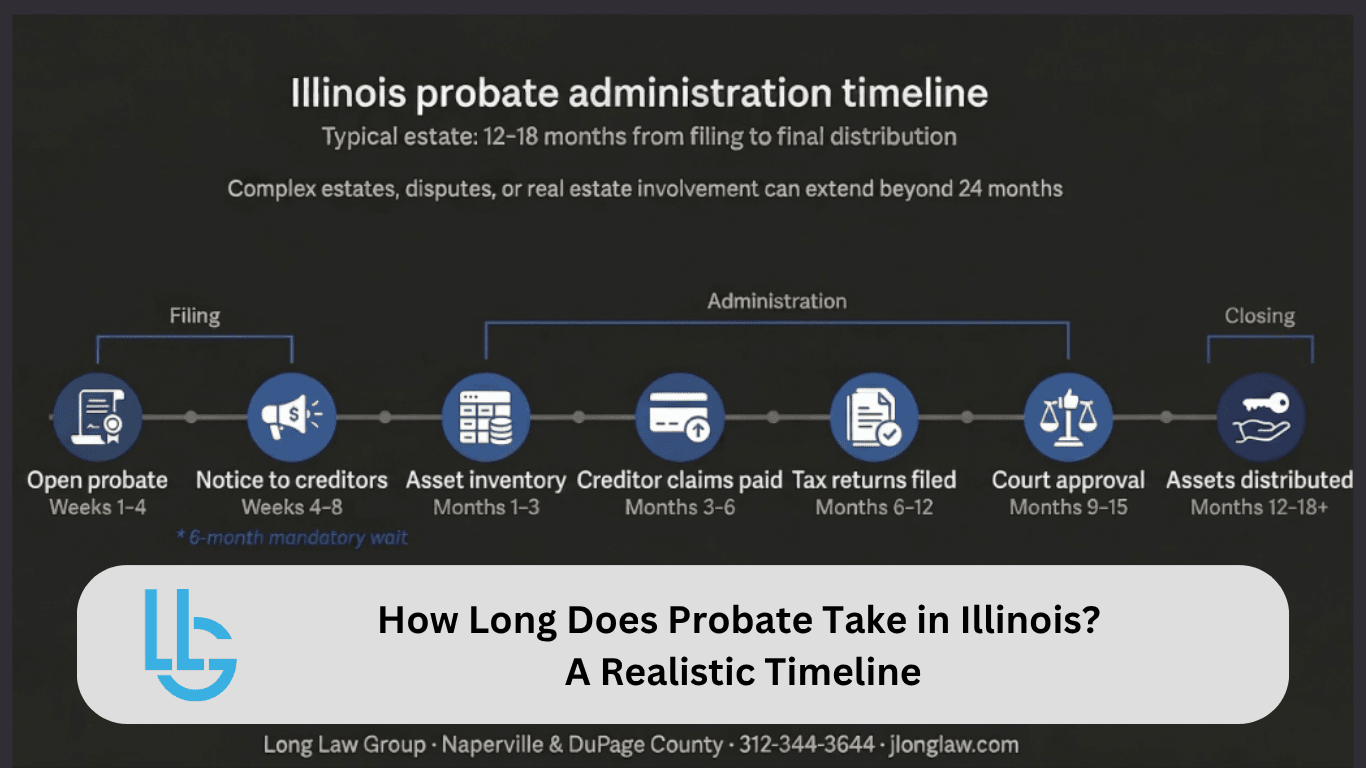
Here’s a realistic breakdown of what the process looks like:
| Phase | Typical Timeline |
| Open probate (petition filed) | Weeks 1–4 |
| Notice to creditors published | 6 months (mandatory waiting period) |
| Asset inventory & appraisal | Months 1–3 |
| Creditor claims reviewed & paid | Months 6–9 |
| Tax returns filed (if required) | Months 6–12 |
| Final accounting & court approval | Months 9–15 |
| Assets distributed to heirs | Months 12–18+ (typical) |
Bottom line: Plan for at least 12 months. If the estate is complex, has out-of-state property, involves a business, or creditors dispute claims, 18 to 24 months is more realistic.
Phase 1: Opening the Estate (Weeks 1–4)
The process begins when the executor (named in the will) or an administrator (appointed by the court if there’s no will) files a petition with the probate court.
This involves:
- Filing the petition to open probate
- Submitting the original will for validation
- Receiving Letters of Office, which authorize the executor to act on behalf of the estate
Letters of Office are the key document. Without them, the executor can’t access bank accounts, manage real property, or communicate with financial institutions.
In DuPage County, this initial step typically takes two to four weeks, depending on court scheduling.In Cook County, this initial step typically takes six to eight weeks.
Phase 2: The Six-Month Creditor Period (Months 1–7)
Illinois law requires that notice be published in a local newspaper to alert potential creditors. Once published, creditors have six months to file claims against the estate.
This is a mandatory waiting period. There is no way to skip it.
During this time, the executor should be:
- Creating a complete inventory of all assets and their appraised values
- Securing and managing estate property
- Opening an estate bank account to handle incoming funds and pay expenses
- Communicating with known creditors
This phase often determines the overall timeline. An organized executor who moves quickly can set the estate up for a smooth resolution. Delays here — missed creditors, undiscovered assets, unresponsive financial institutions — push everything back.
Phase 3: Paying Debts and Filing Taxes (Months 6–12)
Once the creditor period closes, the executor reviews all claims and pays valid debts. This includes:
- Funeral and burial expenses
- Outstanding medical bills
- Mortgages, car loans, and other secured debts
- Credit card and personal loan balances
- Attorney and executor fees
Tax obligations must also be addressed:
- Final income tax return: Filed for the year of death
- Estate income tax return: Required if the estate generates income during administration
- Federal estate tax: Only applies to estates over $13.6 million (2026 federal exemption)
- Illinois estate tax: Applies to estates over $4 million — a meaningful threshold for many Illinois families with real estate and retirement assets
The Illinois estate tax threshold is significantly lower than the federal threshold. If the estate is close to or above $4 million, working with both a probate attorney and a CPA is strongly recommended.
Phase 4: Final Accounting and Distribution (Months 9–18+)
Before assets can be distributed, the executor must prepare a final accounting — a detailed record of all income received, debts paid, and expenses incurred during administration.
This accounting is submitted to the court for approval. Heirs and beneficiaries have the opportunity to review and object before the judge signs off.
Once approved:
- Deed transfers are recorded for real estate
- Financial accounts are retitled or liquidated
- Personal property is distributed per the will
- The estate is formally closed
If heirs disagree on distributions or if a will is contested, this phase can extend significantly. Will contests in Illinois can add months or even years to the timeline.
What Causes Probate to Take Longer?
Several factors can slow down an Illinois probate case:
- Real estate: Property sales, title issues, or heir disagreements over the family home are among the most common sources of delay
- Out-of-state assets: Property in another state may require an “ancillary probate” proceeding in that state
- Family disputes: Contested wills, questions about undue influence, or disagreements between siblings can extend timelines dramatically
- Missing heirs: The court requires diligent efforts to locate all interested parties
- Complex business interests: Business valuations and succession issues can add months
Can You Avoid Probate Entirely?
Yes — and many Illinois families do with proper planning.
Common probate-avoidance strategies include:
- Revocable Living Trust: Assets held in trust pass directly to beneficiaries without court involvement
- Transfer on Death Instruments (TODI): Illinois-specific tool that allows real estate to pass directly to named heirs outside probate
- Joint Tenancy with Right of Survivorship: Property passes automatically to the surviving owner
- Beneficiary Designations: Retirement accounts, life insurance, and POD bank accounts pass outside the estate
- Small Estate Affidavit: Available for estates under $150,000 (excluding motor vehicles)
The best strategy depends on the size and complexity of your estate, your family situation, and your goals. An Illinois estate planning attorney can help you build a plan that minimizes, or eliminates, the need for probate.
Frequently Asked Questions
Do I need an attorney for Illinois probate?
Yes, you are required to have an attorney to open or administer a probate estate. Errors in the probate process can cause delays, court rejection of documents, or personal liability for the executor.
What happens if there’s no will in Illinois?
Illinois intestacy law determines who inherits. Generally, assets pass 50% to a surviving spouse, 50% to the children, then to other relatives if the decedent was not married or had no children. The court will appoint an administrator (usually a close family member) to manage the estate. Without a will, there’s no guarantee the estate will be distributed the way the deceased would have wanted.
Can probate assets be accessed before the process is complete?
Not without court authorization. Once the estate is opened and the executor receives Letters of Office, they can manage and preserve assets — but full distribution to heirs typically has to wait until debts are paid, taxes are filed, and the court approves the final accounting.
What is supervised vs. unsupervised probate in Illinois?
In Illinois, most probates proceed as independent administration — meaning the executor can act without court approval for most decisions. Supervised administration requires court approval for major actions and is generally slower. Courts may require supervised administration when there are disputes or concerns about the executor’s conduct.
Navigating Illinois Probate? We Can Help.
Losing a loved one is hard enough. Navigating the probate process on top of grief — with creditors calling, courts to file with, and family members looking to you for answers — can feel overwhelming.
At Long Law Group, we guide families throughout Naperville, DuPage County, and the greater Chicagoland area through every phase of Illinois probate and estate administration. We help executors meet deadlines, avoid costly mistakes, and close estates efficiently.
Call us at 312-344-3644 or email Contact@JLongLaw.com to schedule a consultation. We’re here to make this process as smooth as possible for your family.
Additional Articles about Personal Injury

Informational/Promotional Content: The content of this website is informational and/or promotional and not for the purpose of providing legal advice. To obtain legal advice, please contact Long Law Group or your attorney with respect to any particular issue or problem. No Attorney-Client Relationship Created by Use of this Website: Neither your receipt of information from this website nor your use of this website to contact Long Law Group creates an attorney-client relationship between you and Long Law Group or any of its employees. As a matter of policy, Long Law Group does not accept a new client without first investigating for possible conflicts of interest and obtaining a signed engagement letter. Accordingly, you should not use this website to provide confidential information about a legal matter of yours.