Illinois Small Estate Affidavit: The $150,000 Threshold Explained
By Long Law Group —Probate and Estate Administration Attorneys proudly serving families throughout Naperville, Warrenville, DuPage County, Cook County, Will County, Kane County, and the greater Chicagoland area.
When someone you love passes away, the paperwork shouldn’t be the hardest part. But for many families in Naperville, DuPage County, and across Chicagoland, it is. Bank accounts freeze. Institutions ask for “letters of office” you’ve never heard of. And suddenly you’re wondering whether you need to open a probate case just to close out a modest estate.
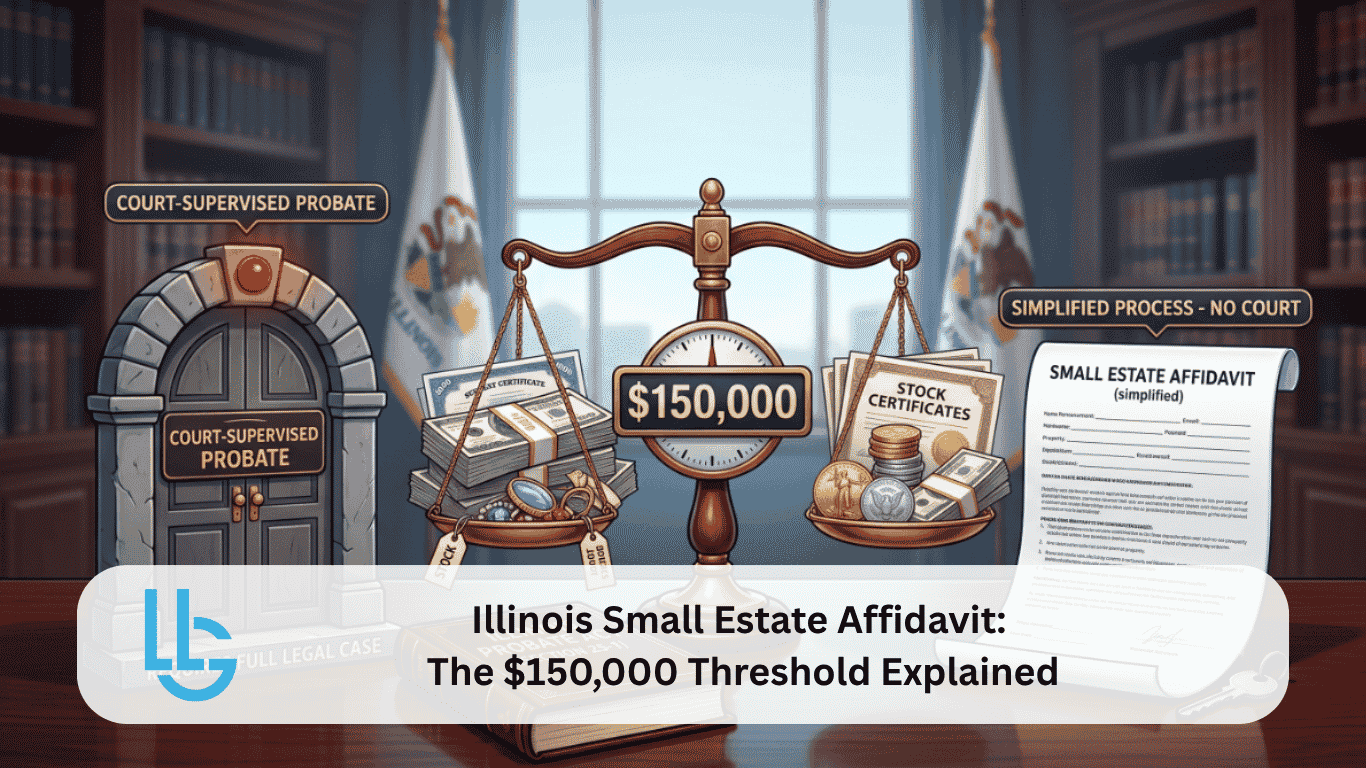
Often, you don’t. Illinois law gives families a shortcut called the small estate affidavit, and it recently got a major upgrade. For anyone who dies on or after August 15, 2025, the limit jumps from $100,000 to $150,000, and vehicles no longer count toward it at all.
Here’s how the Illinois small estate affidavit works, who qualifies, and where families tend to get tripped up.
What a Small Estate Affidavit Actually Does
A small estate affidavit is a sworn legal document that lets you collect and distribute a loved one’s personal property without opening a probate case. No court proceedings, no waiting on a judge. You present the affidavit, along with a certified death certificate, to the bank or institution holding the assets, and Illinois law requires them to release the property.
It covers personal property only: bank accounts, investment accounts, final paychecks, refunds, and similar assets. The process is governed by Section 25-1 of the Illinois Probate Act, and when an estate fits within it, it can save a family months of time and thousands of dollars in court costs.
The New $150,000 Limit, and Why Vehicles Don’t Count
For years, the cutoff was $100,000, and every asset counted, including cars. With vehicle prices what they are, a modest estate with two cars in the driveway could blow past the limit and force a probate case over what was really just a few bank accounts.
The Illinois General Assembly fixed that. For anyone who dies on or after August 15, 2025, the limit is $150,000 in personal property, and motor vehicles registered with the Illinois Secretary of State are excluded from that total entirely. Vehicles can now be transferred through the Secretary of State by affidavit no matter what they’re worth.
So a parent who leaves $130,000 in accounts and a $45,000 truck still qualifies. Under the old rule, that same family would have been headed to probate court.
Here’s some other good news: assets that pass automatically at death, like joint accounts, life insurance with a named beneficiary, and payable-on-death accounts, don’t go through the affidavit at all, and they don’t count toward the $150,000 either. The limit only measures property that would otherwise pass through a will or Illinois intestacy law. For many families, that means the estate is smaller than they think.
When You Can Use One, and When You Can’t
The affidavit is only available when the estate checks every box. Miss one, and a bank is within its rights to refuse it. To qualify:
- The personal property, not counting Illinois-registered vehicles, totals $150,000 or less
- The estate includes no real estate
- No probate case has been opened, and none is planned, in Illinois or anywhere else
- If there’s a will, it has been filed with the circuit court clerk in the county where your loved one lived
- The heirs and beneficiaries aren’t fighting over who gets what
That second item trips up more families than any other. If your loved one owned a home, a condo, or even a share of farmland, the affidavit can’t transfer it. Real estate still requires probate, or planning done in advance, like a living trust or a transfer-on-death instrument.
The Responsibility You Take On When You Sign
Here’s the part families don’t always appreciate: the person who signs the affidavit takes on personal legal responsibility for getting it right.
You’re swearing, under penalty of perjury, that the estate qualifies and that you’ll pay the decedent’s debts in the order Illinois law requires. Funeral and burial expenses come first, other classes of creditors follow, and only after that do heirs get paid.
We’ve seen well-meaning family members distribute money to siblings before settling a final medical bill, then end up personally liable for the difference. The affidavit is a real shortcut, but it doesn’t erase the debts. A short conversation with an attorney before you sign can keep a simple process simple.
Affidavit or Probate? How to Decide
Sometimes probate is the safer route even when the estate technically qualifies. A few signs that a court-supervised process may serve your family better:
- Heirs disagree about the will or the distribution
- There are more debts than assets, or creditors you can’t identify
- You’re not confident you’ve found everything the person owned
- Someone may contest the will
Probate has a bad reputation, and sometimes it’s earned. But it also gives the estate’s representative court protection that an affidavit doesn’t. Which route fits depends on the family, not just the numbers.
Questions We Hear From Families Settling an Estate
Does the affidavit work if there’s no will?
Yes. With a will, the property is distributed according to its terms. Without one, Illinois intestacy law decides who inherits. The affidavit works either way; it just changes who receives what.
My loved one died before August 15, 2025. Which limit applies?
The old one. The $150,000 limit applies only to people who die on or after August 15, 2025. If the death came before that date, the $100,000 cap still controls, and vehicles count toward it.
How long do we have to wait before using the affidavit?
Illinois doesn’t impose a waiting period. In practice, most families need a few weeks to gather account statements, confirm the estate qualifies, and obtain certified death certificates. Moving carefully at the start prevents problems later.
The bank refuses to accept our affidavit. Now what?
It happens more often than it should. Some institutions demand letters of office out of habit, even when the law doesn’t require them. Attaching a copy of the statute helps, and so does a letter from an attorney. If the estate qualifies, the institution is required to honor a properly prepared affidavit.
You Shouldn’t Have to Guess at This
Losing someone is hard enough without decoding the Probate Act on your own. The expanded small estate affidavit means more Illinois families than ever can skip probate, but only if the paperwork is done right the first time.
At Long Law Group, we help families throughout Naperville, Warrenville, DuPage County, and the greater Chicagoland area evaluate whether a small estate affidavit fits, prepare one that banks will accept, and step in with probate when that’s the better path.
Need Help Settling an Estate?
Contact Long Law Group today to schedule a consultation.
Phone: 312-344-3644
Email: Contact@JLongLaw.com

Informational/Promotional Content: The content of this website is informational and/or promotional and not for the purpose of providing legal advice. To obtain legal advice, please contact Long Law Group or your attorney with respect to any particular issue or problem. No Attorney-Client Relationship Created by Use of this Website: Neither your receipt of information from this website nor your use of this website to contact Long Law Group creates an attorney-client relationship between you and Long Law Group or any of its employees. As a matter of policy, Long Law Group does not accept a new client without first investigating for possible conflicts of interest and obtaining a signed engagement letter. Accordingly, you should not use this website to provide confidential information about a legal matter of yours.