Using a TODI to Avoid Probate: A Guide to Illinois Transfer on Death Instruments
By Long Law Group — Estate Planning and Estate Administration Attorneys Serving Naperville, DuPage County, and the Chicagoland area.
If you own a home in Naperville, Wheaton, or anywhere else in DuPage County, your house is probably your largest asset. It is also the asset most likely to drag your family into Illinois probate court after you pass away.
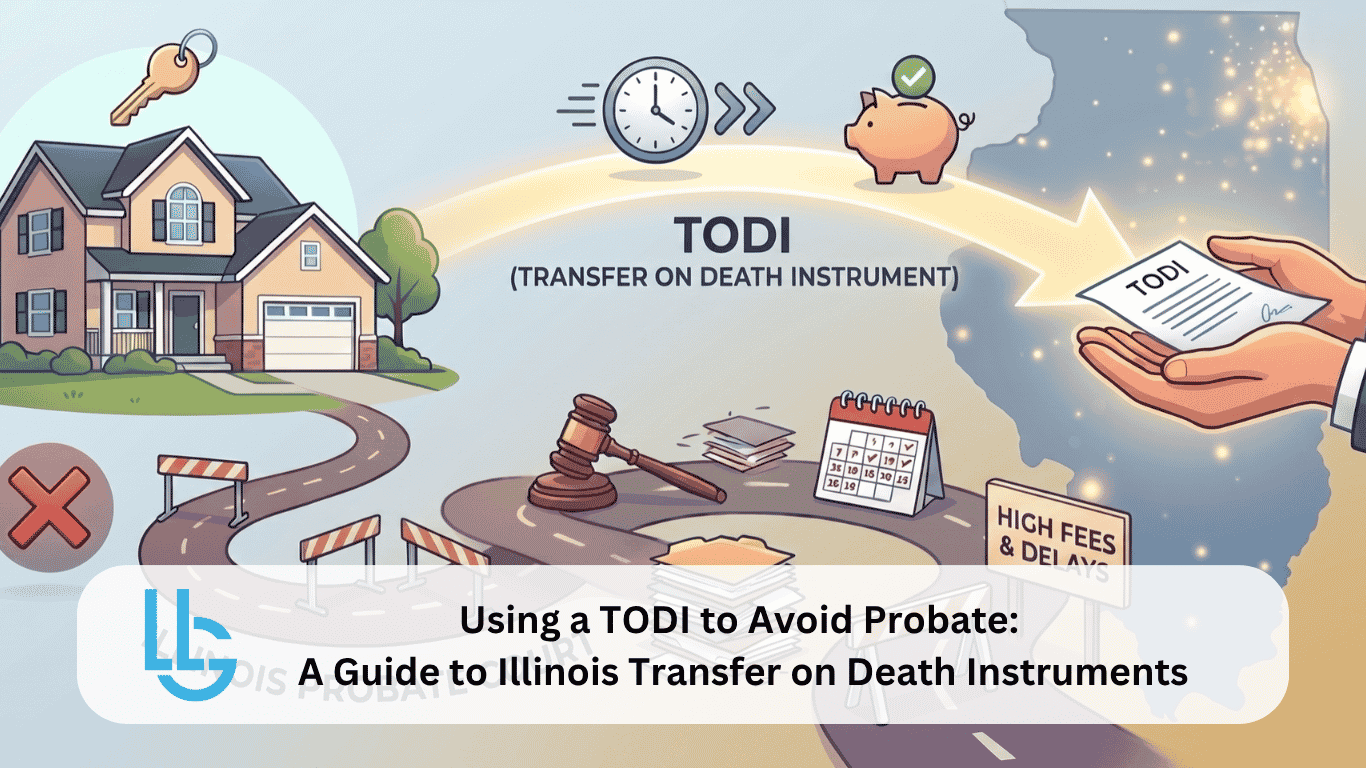
A Transfer on Death Instrument, or TODI, is one of the simplest and most affordable tools Illinois law offers to keep your real estate out of probate. Done correctly, it allows your home to pass directly to your chosen beneficiary the moment you die, with no court hearing, no probate attorney bill for that asset, and no months of waiting.
This guide explains how a TODI works in Illinois, when it makes sense, when it does not, and the strict requirements you must follow for it to be valid.
What Is a Transfer on Death Instrument?
A Transfer on Death Instrument is a recorded legal document that names one or more beneficiaries to receive your real estate when you die. It is governed by the Illinois Real Property Transfer on Death Instrument Act, 755 ILCS 27/1.
Think of it as a beneficiary designation for your house, similar to the one on your life insurance policy or 401(k). While you are alive, nothing changes. You still own the property, you can sell it, refinance it, or rent it out, and your beneficiary has no rights to it.
When you die, ownership transfers automatically to your named beneficiary, completely outside the probate process.
The 2022 Expansion
Illinois originally limited TODIs to residential property when the law took effect in 2012. That changed on January 1, 2022, when Public Act 102-68 expanded the law to cover all real property in Illinois.
Today, a TODI can be used for nearly any real estate you own in the state, including:
- Your primary residence in Naperville, Lisle, or Aurora
- A vacation home or rental property
- Vacant land
- Commercial buildings
- Multi-unit apartment buildings
Why Avoiding Probate Matters in Illinois
When real estate passes through a will alone, that property typically must go through probate court. For families in DuPage and Cook County, the consequences add up quickly.
- Time. Illinois probate routinely takes 9 to 18 months, sometimes longer for contested estates.
- Cost. Court fees, publication costs, and attorney fees can consume thousands of dollars from the estate.
- Privacy. Probate is a public court process. Anyone can look up what your home was worth and who inherited it.
- Family stress. Family stress. Beneficiaries often must wait until probate closes to sell, refinance, or move into the property.
A properly drafted TODI sidesteps all of this for the property it covers. The home transfers as a non-probate asset, just like a payable-on-death bank account.
Strict Requirements for a Valid Illinois TODI
A TODI is only as good as its execution. Illinois law requires every one of the following, and missing even one can invalidate the entire instrument.
1. Proper Form and Content
The TODI must be in writing and contain the same essential elements as a recordable deed, including a complete legal description of the property and clear identification of the beneficiary. It must also expressly state that the transfer takes effect at the owner’s death.
2. Signed, Witnessed, and Notarized
The owner must sign the TODI in the presence of two credible witnesses and a notary public. The witnesses must also sign in front of the notary.
Critical rule: a beneficiary or the beneficiary’s spouse cannot serve as one of the required witnesses. If they do, that beneficiary’s interest may be voided.
3. Recorded Before Death
This is where many do-it-yourself TODIs fail. The signed TODI must be recorded with the County Recorder of Deeds in the county where the property sits, and it must be recorded before the owner dies.
If the TODI is found in a desk drawer after death and was never recorded, it has no legal effect. The property will pass through probate or under the will instead.
4. Mental Capacity
The owner must have testamentary capacity, the same standard required to make a will. They must understand what property they own, who would naturally inherit, and what the TODI is doing.
Important: an agent acting under a power of attorney cannot create or revoke a TODI, even if the POA grants broad real estate authority.
Thinking about a TODI for your home? Long Law Group helps Naperville and DuPage County families decide whether a TODI, a living trust, or a different strategy fits their estate plan. Call 312-344-3644 to schedule a free consultation.
How a TODI Works After Death
When the owner dies, the named beneficiary becomes the legal owner of the property as of the date of death. To finalize and clean up title, the beneficiary should take two practical steps.
- Step 1: Order a certified copy of the death certificate from the county where the owner died.
- Step 2: Record a Notice of Death Affidavit and Acceptance with the same Recorder of Deeds office where the TODI was filed. This must happen within two years of death, or the TODI may be rendered void.
Once the affidavit is recorded, title officially shows the beneficiary as the new owner, and the property can be sold, refinanced, or transferred normally.
TODI vs. Living Trust: Which Is Right for You?
Both tools avoid probate for real estate, but they serve different planning needs.
A TODI may be the better fit when:
- Your real estate is your only major probate asset
- You want a simple, low-cost solution
- You have one clear beneficiary or a small group of adult beneficiaries
- You want to keep full control during your lifetime with minimal paperwork
A living trust is usually better when:
- You own multiple properties or significant non-real-estate assets
- You want to provide for minor children or a beneficiary with special needs
- You want detailed control over how and when beneficiaries receive property
- You want a single document that handles incapacity planning as well
Many Illinois families end up using both: a living trust for the bulk of the estate, and a TODI as a focused backup for a specific property.
Common TODI Mistakes to Avoid
In our work with DuPage County families, we see the same TODI mistakes repeat themselves. The most damaging include:
- Failing to record. Failing to record. An unrecorded TODI is worthless. Always confirm the document was filed with the Recorder of Deeds.
- Wrong legal description. Wrong legal description. A copy of the address is not enough. Use the legal description from the deed or the Property Index Number.
- Letting a beneficiary witness the signing. Letting a beneficiary witness the signing. This single mistake can wipe out that beneficiary’s inheritance.
- Forgetting to update after life changes. Forgetting to update after life changes. Divorce, a beneficiary’s death, or new family members are all reasons to revoke and re-record.
- Trying to revoke through a will. Trying to revoke a TODI through a will. Illinois law requires either a new recorded TODI or a recorded revocation document.
Frequently Asked Questions About Illinois TODIs
Does a TODI override my will?
Yes, for the property it covers. Property listed in a properly recorded TODI passes to the named beneficiary regardless of what your will says about that same property.
Can I name multiple beneficiaries?
Yes. You can name several beneficiaries and specify how they share ownership. You can also name backup or contingent beneficiaries in case your primary beneficiary dies before you do.
Are there creditor risks for the beneficiary?
Yes. Illinois law allows certain creditors of the deceased owner to make claims against TODI property after death. This is one reason many estate plans pair a TODI with broader liability and tax planning.
Can I change or cancel a TODI?
Yes, at any time before death, as long as you have mental capacity. You revoke a TODI by recording either a new TODI or a separate revocation instrument. A will cannot revoke a TODI.
How much does it cost to record a TODI?
Recording fees vary by Illinois county and typically run between $45 and $100, depending on page count. DuPage and Cook County recorders publish current fee schedules online.
Talk to an Illinois Estate Planning Attorney
A TODI is a powerful, affordable tool, but it is not the right fit for every family. Choosing between a TODI, a living trust, or a combination requires a careful look at your assets, your beneficiaries, and your long-term goals.
At Long Law Group, we help Naperville, Wheaton, Aurora, and greater Chicagoland families build estate plans that protect their homes and their loved ones. Whether you need a single TODI or a comprehensive plan, we will explain your options in plain English.
Schedule Your Estate Planning Consultation Call: 312-344-3644 Email: Contact@JLongLaw.com Serving Naperville, DuPage County, and the greater Chicagoland area.
Additional Articles Estate Planning and Probate Articles

Informational/Promotional Content: The content of this website is informational and/or promotional and not for the purpose of providing legal advice. To obtain legal advice, please contact Long Law Group or your attorney with respect to any particular issue or problem. No Attorney-Client Relationship Created by Use of this Website: Neither your receipt of information from this website nor your use of this website to contact Long Law Group creates an attorney-client relationship between you and Long Law Group or any of its employees. As a matter of policy, Long Law Group does not accept a new client without first investigating for possible conflicts of interest and obtaining a signed engagement letter. Accordingly, you should not use this website to provide confidential information about a legal matter of yours.