Your Child Turns 18: The Legal Documents Every Illinois Family Needs
By Long Law Group — Illinois Estate Planning Attorneys proudly serving families throughout Naperville, Warrenville, DuPage County, Cook County, Will County, Kane County, and the greater Chicagoland area.
August in Naperville and across DuPage County means school supply runs, dorm move-in dates, and a lot of parents quietly realizing that the kid in the passenger seat is now a legal adult.
That birthday changes more than most families expect. The day your child turns 18 in Illinois, you stop being the person a hospital calls, a bank will talk to, or a university sends the tuition account to. You are still the parent. You are simply no longer the decision maker, and paying the bills or carrying your child on your insurance doesn’t change that.
We’ve had parents sit in emergency rooms in DuPage and Cook County unable to get a straight answer about their own child, because one short document had never been signed. Fixing it ahead of time takes an afternoon.
What Actually Changes on Your Child’s Eighteenth Birthday
Eighteen is the age of majority in Illinois. Your child can sign contracts, open accounts, consent to medical treatment, and refuse it. Those rights belong to your child alone, and privacy law backs them up.
Three doors close on parents that day:
- Medical information. HIPAA keeps providers from discussing your adult child’s care with you without written authorization.
- Medical decisions. If your child can’t speak for themselves, you have no automatic authority to decide anything.
- Money and paperwork. Bank accounts, leases, insurance claims, financial aid, and phone contracts are no longer yours to handle.
It doesn’t matter that you claim your child as a dependent, and it doesn’t matter who writes the checks. Legal adulthood isn’t means-tested.
Isn’t a Parent Automatically Next in Line?
Not the way most families assume. Illinois does have a Health Care Surrogate Act, and it lets a hospital identify someone to decide for a patient who can’t decide for themselves. Parents are on that list.
But the list is a fallback, not a plan, and it comes with real limits. A physician has to determine first that your child lacks decisional capacity and document that finding. The order of priority puts a court-appointed guardian and a spouse ahead of parents. Decisions about life-sustaining treatment require a qualifying condition under the Act. And if divorced parents disagree, the statute pushes that disagreement toward guardianship court.
None of that helps at eleven at night when you’re trying to learn whether your daughter is in surgery. The surrogate statute answers who decides in a crisis, but it doesn’t give you access to records, and it doesn’t apply at all when your child has capacity and is simply too sick, too sedated, or too far away to handle things. You want a document with your name on it, signed in advance.
The Three Documents to Sign Before the Semester Starts
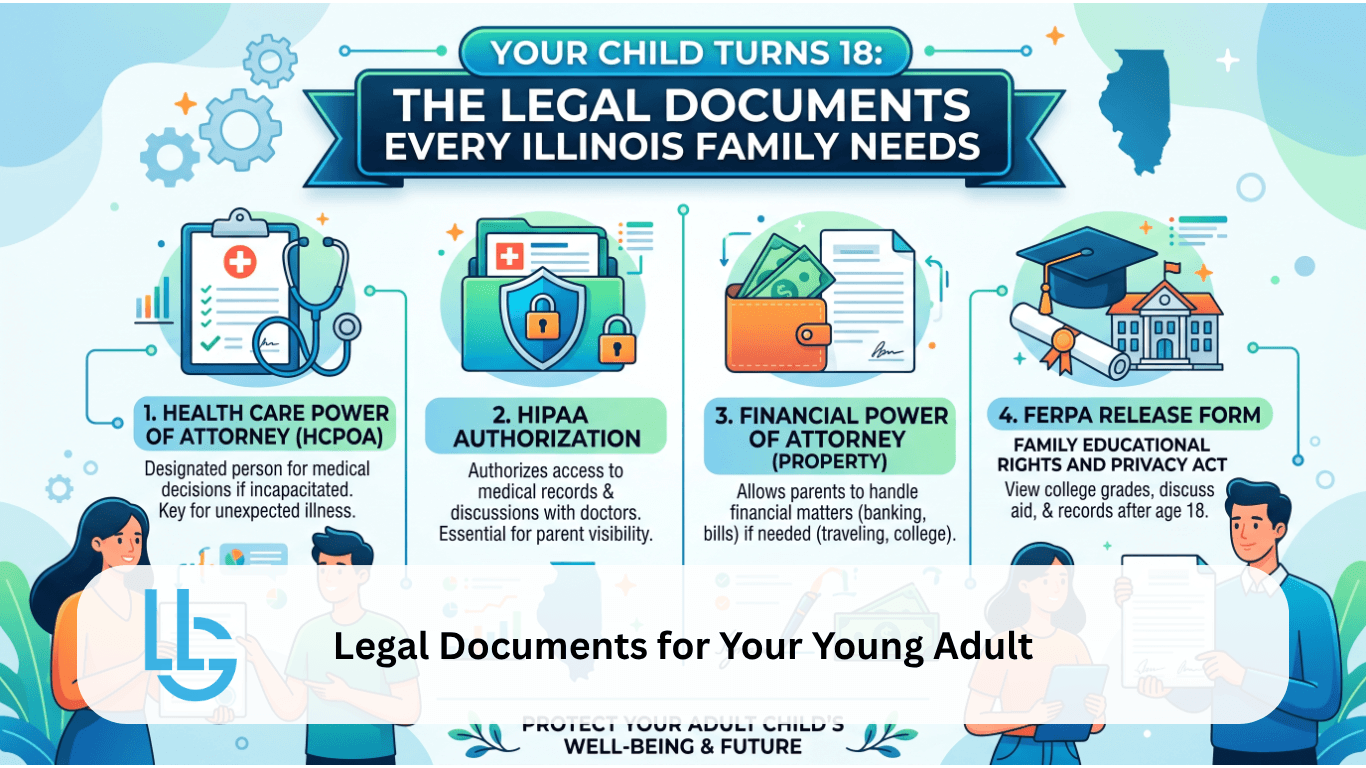
Illinois Power of Attorney for Health Care
This is the one that matters most. Your child names you, or another trusted adult, as the agent who can make medical decisions if your child can’t. Illinois has a statutory short form, and completing it is straightforward, but choosing an agent and a successor agent deserves a real conversation rather than a quick signature at the kitchen counter.
A few practical notes. Always name a successor in case you’re unreachable. Keep a photo of the signed form on your child’s phone and on yours, because Illinois law says a provider can’t refuse to honor a health care agency just because the agent is showing an electronic copy on a device. And if your child is leaving the state for school, tell us where, since campus health center staff don’t always know how an out-of-state directive is treated.
HIPAA Authorization
The health care power of attorney covers decisions. A HIPAA authorization covers information, and the two documents do different jobs.
With a signed authorization, providers can tell you about a diagnosis, a test result, or a prescription without waiting for your child to lose capacity first. That covers the ordinary situations, and ordinary is most of what actually comes up: a sprained ankle in Champaign, a bad reaction to a new medication, a billing dispute with a clinic in Evanston.
Many universities also have their own release form for their campus health service. Have your child sign that one too. It doesn’t replace a properly drafted authorization, but it removes one more point of friction on a bad day.
Illinois Power of Attorney for Property
If your child is hospitalized, deployed, studying abroad, or just unreachable, this document lets you deal with the bank, the landlord, the insurer, and the school’s business office.
Parents sometimes hesitate here, and we understand why, because it feels like a lot of authority to hand over at 18. The document can be drafted narrowly, and it can be written so the authority only takes effect on incapacity if that’s what your family is comfortable with. Any of those versions beats scrambling in the middle of a crisis.
Illinois Made These Documents Harder to Ignore in 2025
Anyone who has handed a power of attorney to a bank and been told “we need our own form” knows how that goes. Illinois addressed it.
Public Act 103-0994 took effect on January 1, 2025, amending the Illinois Power of Attorney Act to spell out when a third party may and may not refuse to honor a properly executed statutory short form. Being on the wrong letterhead is not a valid reason. Neither is the fact that the document is a few years old. The Act also gives banks and other institutions a way to protect themselves, by asking the agent to certify under penalty of perjury that the authority is still in force.
What that means for your family is practical. A properly drafted Illinois power of attorney carries more weight at the counter than it did two years ago, so bring the document with you and don’t treat a refusal as the last word.
You’re Paying the Tuition. You Still Can’t See the Grades.
FERPA is the other surprise. Once your child enrolls at a college or university, the education records belong to the student regardless of who pays for the semester. That includes grades, disciplinary records, and often the account holding the balance you’re being asked to cover.
Schools are permitted to release records to the parents of a tax-dependent student, but most treat that as discretionary and ask for the student’s written consent anyway. Every Illinois school we deal with has a form for it. Signing that form takes five minutes during orientation week, and it’s a much easier conversation then than it is in the middle of a semester that’s going badly.
When Your Adult Child Has a Disability
For some Illinois families, the eighteenth birthday raises a harder question. If a young adult can’t make or communicate their own decisions because of a developmental or cognitive disability, powers of attorney may not be an option at all, because signing one requires understanding what’s being signed.
Illinois offers a range of responses, and full guardianship is only one of them. Limited guardianship reaches only the areas where support is actually lacking. Supported decision-making arrangements, representative payee status for Social Security benefits, and a special needs trust can each fill part of the gap without stripping away rights your child can still exercise.
Timing matters here more than families expect. Guardianship petitions in DuPage County are usually filed as the birthday approaches so that the authority exists when it’s needed rather than months afterward. If this is your family’s situation, start the conversation the spring before, not the week of.
Questions We Hear From Illinois Parents
Our son is going to College of DuPage and living at home. Do we still need this?
Yes. Distance isn’t what creates the problem, and legal adulthood is. A car accident on Route 59 puts you in the same position as a phone call from three states away, and living under your roof gives you no legal authority you wouldn’t otherwise have.
Can my child limit what I’m allowed to see or decide?
Absolutely, and it’s often the right approach. These documents belong to your child to shape. Your child can name you for medical matters only, restrict which categories of information get released, or name a different trusted adult for a particular role. Framing the conversation that way tends to make it go a lot easier.
What if our daughter signs and then changes her mind?
She can revoke any of these documents at any time while she has capacity. That is worth saying out loud to a hesitant 18-year-old, because much of the resistance we hear comes from a fear of signing something permanent.
Do these documents still work if our child goes to school out of state?
Generally, yes. Most states honor an advance directive that was validly executed in another state, though paperwork practices vary from one hospital system to the next. Tell us where your child is headed and we’ll draft the documents so they travel well.
How long does all of this take?
For most families, one meeting. These are short documents, and the substance is in choosing the right agents and talking through what your child actually wants.
Sign the Paperwork While It’s Still Boring
Your child’s eighteenth birthday doesn’t arrive with a notice explaining what changed. Most families find out the hard way, in a waiting room or on the phone with a bank, and by then the fix takes weeks instead of an afternoon.
At Long Law Group, we help families across Naperville, Warrenville, and DuPage County get these documents signed before the school year starts. It’s one of the shortest and least expensive things we do, and it’s one of the few that families come back years later to thank us for.
Need Help Preparing the Right Documents?
Contact Long Law Group today to schedule a consultation.
Phone: 312-344-3644
Email: Contact@JLongLaw.com
Additional Estate Planning Articles

Informational/Promotional Content: The content of this website is informational and/or promotional and not for the purpose of providing legal advice. To obtain legal advice, please contact Long Law Group or your attorney with respect to any particular issue or problem. No Attorney-Client Relationship Created by Use of this Website: Neither your receipt of information from this website nor your use of this website to contact Long Law Group creates an attorney-client relationship between you and Long Law Group or any of its employees. As a matter of policy, Long Law Group does not accept a new client without first investigating for possible conflicts of interest and obtaining a signed engagement letter. Accordingly, you should not use this website to provide confidential information about a legal matter of yours.