Understanding Comparative Negligence in Illinois Injury Cases
By Long Law Group — Illinois Personal Injury Attorneys proudly serving families throughout Naperville, Warrenville, DuPage County, Cook County, Will County, Kane County, and the greater Chicagoland area.
The adjuster calls a few days after the crash, sounds friendly, asks how you’re feeling, and somewhere in the middle of it says something like: you were going a little fast yourself, weren’t you?
That question isn’t small talk. In Illinois, how you answer it can be worth tens of thousands of dollars, and in a close case it can be worth the entire claim.
Illinois uses a system called modified comparative negligence. It’s the rule that decides what happens when more than one person contributed to an accident, and it’s the reason insurance companies start building a case against you before you’ve finished physical therapy.
The Rule, in One Paragraph
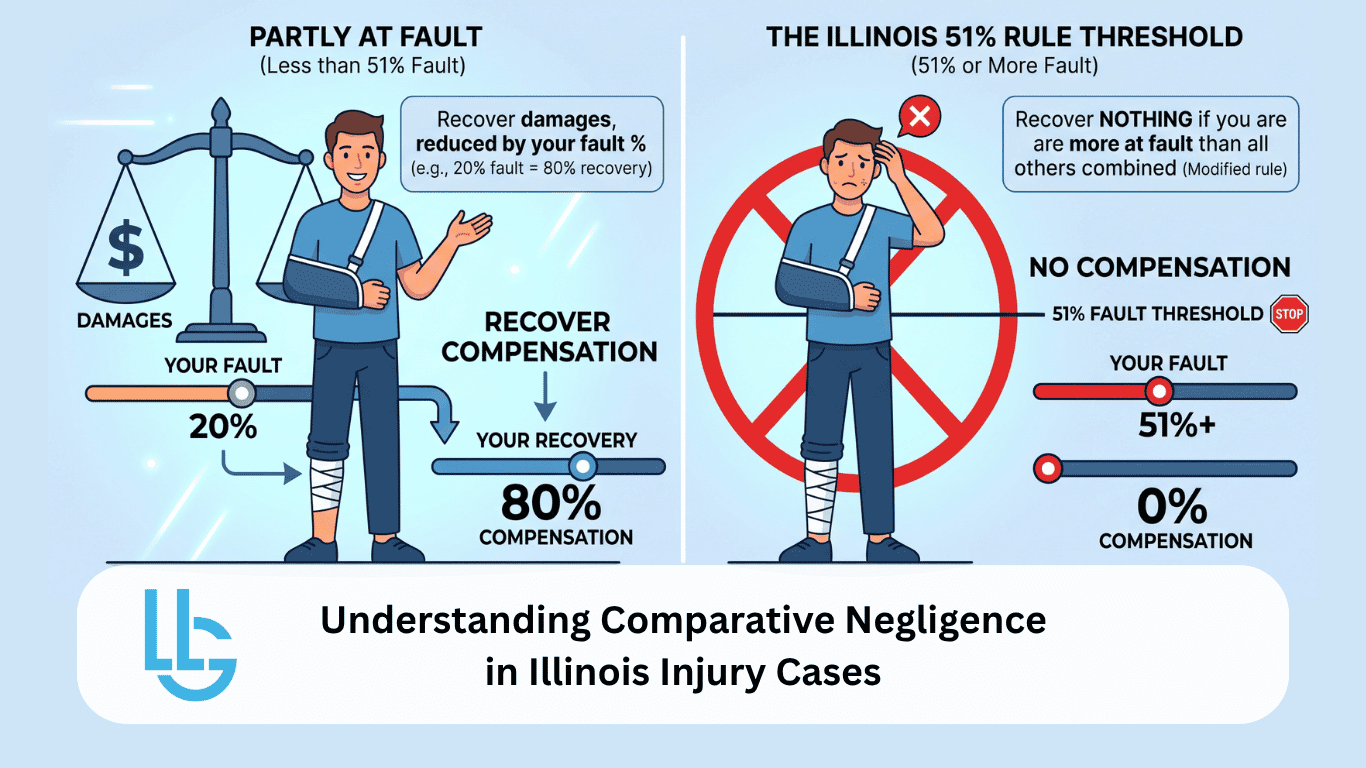
Under 735 ILCS 5/2-1116, you can recover damages as long as your share of the fault is 50% or less, and your recovery is reduced by whatever percentage gets assigned to you. If you’re found more than 50% at fault, you recover nothing at all.
Lawyers call it the 51% bar, and there’s nothing gradual about it.
What That Looks Like in Real Numbers
Say a jury values your case at $200,000.
- Found 0% at fault, you recover $200,000
- Found 20% at fault, you recover $160,000
- Found 50% at fault, you recover $100,000
- Found 51% at fault, you recover nothing
Look at those last two lines again. One percentage point separates a six-figure recovery from zero, which is why the argument over your fault percentage usually is the case.
Why the Insurer Starts Arguing Fault on Day One
Every point of fault an adjuster can attach to you is money the insurance company doesn’t pay. At the low end it shaves the settlement, and at the high end it wipes out the claim entirely. There’s no version of this where they’re not thinking about it from the first phone call.
We’ve had clients tell us they apologized at the scene, because that’s what decent people do when something terrible happens in front of them. Months later that apology turned up in the adjuster’s file, described as an admission. It wasn’t one, and we said so, but it took real work to unwind.
The Arguments Insurers Use Most
In DuPage County and Cook County cases, the same handful of arguments come up again and again.
Speed, because even a few miles per hour over the limit gives them something to point at.
Distraction, since phone records get subpoenaed in serious cases and a text sent two minutes before impact will be used.
Failure to keep a proper lookout, which is the catch-all argument that you should have seen it coming.
Gaps in treatment: if you waited three weeks to see a doctor, or missed a stretch of appointments, expect to hear that you failed to mitigate your own damages.
Pre-existing conditions, because they’ll argue the back pain was already there. Sometimes it partly was, which is exactly why the medical records matter so much.
Positioning, particularly in pedestrian and bicycle cases, where where you were in the roadway and whether you had the signal become the central questions.
One Argument Illinois Does Not Allow
Whether you were wearing a seat belt.
Under 625 ILCS 5/12-603.1, failure to wear a seat belt is not evidence of negligence in Illinois and cannot be used to reduce what you recover in a negligence claim. Adjusters raise it anyway, sometimes confidently. It doesn’t belong in the calculation.
Who Actually Decides Your Percentage
Not the adjuster, and not the officer who wrote the police report.
Fault percentages are decided by the trier of fact, which means the jury, or the judge in a bench trial. A police report is evidence and it does carry weight with insurers, but officers arrive after the fact, take statements from people who are shaken and hurting, and sometimes get it wrong. Reports get amended and citations get dismissed.
Most cases settle long before a jury sees them, which means both sides are really negotiating against their best guess at what a DuPage County jury would decide. A well-supported version of events moves that guess.
When More Than One Party Is at Fault
Illinois has a second rule that matters whenever several defendants are involved. Under 735 ILCS 5/2-1117:
- Every defendant found liable is jointly and severally liable for your past and future medical expenses, no matter how small their share of the fault
- A defendant found 25% or more at fault is jointly and severally liable for all your other damages as well
- A defendant found less than 25% at fault is severally liable for those other damages, meaning they pay their own share and nothing beyond it
The practical consequence is that if one defendant turns out to be uninsured or judgment-proof, that 25% threshold decides whether the others have to cover the gap. It’s a large part of why identifying every responsible party early matters so much in multi-vehicle collisions and premises cases.
What Actually Keeps Your Percentage Low
Evidence, gathered early, before it disappears.
- Photographs of the scene, the vehicles, and your injuries, taken the same day when that’s possible
- Names and phone numbers of witnesses, who scatter within minutes and are difficult to find later
- Nearby video from businesses, doorbell cameras, and traffic cameras, most of which overwrites itself within days or weeks
- Event data recorder downloads in serious crashes, which can establish speed, braking, and steering input
- Prompt medical treatment, followed by keeping every appointment you’re given
- Nothing posted on social media about the accident or your recovery
One more thing: don’t give a recorded statement to the other driver’s insurer before you’ve talked to an attorney. Those calls are structured to get you saying things that sound like fault.
The Deadline
Illinois gives you two years from the date of injury to file a personal injury lawsuit under 735 ILCS 5/13-202, and wrongful death claims generally carry the same two-year limit. Claims against government entities follow different and considerably shorter deadlines.
Two years sounds like plenty of time. Comparative fault cases need investigation, though, and the evidence that keeps your percentage low is the evidence that disappears first.
Questions We Hear From Injured Clients
The adjuster already told me I was 40% at fault. Is that final?
No. An adjuster’s number is a negotiating position, not a finding. Treat it as their opening offer on the most valuable term in your case.
The police report blames me. Do I still have a claim?
Possibly. A police report isn’t a legal determination of fault, and it can be challenged with witness statements, reconstruction analysis, and physical evidence. We’ve seen fault assessments shift substantially once someone actually went out and investigated.
What if the other driver and I were about equally careless?
At exactly 50% you can still recover, reduced by half. At 51% you recover nothing. When a case sits genuinely near that line, the quality of the investigation is what determines which side of it you land on.
Does comparative negligence apply to slip and fall cases?
Yes. The same rule governs premises liability, product liability, and most other negligence claims. It isn’t limited to car accidents.
Should I just accept the reduced offer and move on?
Not before someone has tested whether their fault percentage actually holds up. Assigned percentages have a way of not surviving a deposition.
If They’re Blaming You, Get Someone in Your Corner
Being partly at fault doesn’t end your claim in Illinois. Being talked into accepting more fault than you deserve can.
Long Law Group represents injured people across Naperville, DuPage County, and the greater Chicagoland area, including the cases insurers call complicated because fault is shared. We investigate what actually happened and hold the number where the evidence puts it.
Hurt in an Accident Where Fault Is Disputed?
Contact Long Law Group today to schedule a consultation.
Phone: 312-344-3644
Email: Contact@JLongLaw.com
Additional Personal Injury Articles
-
- Motorcycle Accident Claims in Illinois: What Makes Them Different
- What to Do After a Car Accident in Illinois: A 2026 Step-by-Step Guide
- Top 10 Questions About Personal Injury Claims Illinois
- Swimming Pool Accidents and Liability in Illinois
- Workers’ Comp vs. Personal Injury in Illinois: Which Claim Should You File?

Informational/Promotional Content: The content of this website is informational and/or promotional and not for the purpose of providing legal advice. To obtain legal advice, please contact Long Law Group or your attorney with respect to any particular issue or problem. No Attorney-Client Relationship Created by Use of this Website: Neither your receipt of information from this website nor your use of this website to contact Long Law Group creates an attorney-client relationship between you and Long Law Group or any of its employees. As a matter of policy, Long Law Group does not accept a new client without first investigating for possible conflicts of interest and obtaining a signed engagement letter. Accordingly, you should not use this website to provide confidential information about a legal matter of yours.