The Complete Guide to Executor Duties in Illinois
By Long Law Group — Illinois Probate and Estate Administration Attorneys proudly serving families throughout Naperville, Warrenville, DuPage County, Cook County, Will County, Kane County, and the greater Chicagoland area.
Being named executor in someone’s will is an honor. It’s also a job, and most people only find out what that job involves after the person who chose them has passed away.
If you’ve been named executor for a parent, spouse, or close friend, you’re stepping into a legal role with real deadlines and real personal responsibility. Illinois law calls you the estate’s “representative,” and the Probate Act of 1975 spells out what duties you owe the estate, the beneficiaries, and the creditors. Some of those duties start the day you learn you were named.
This guide walks through what an Illinois executor actually does, in roughly the order you’ll do it, and where well-meaning people tend to get into trouble.
First Question: Do You Have to Say Yes?
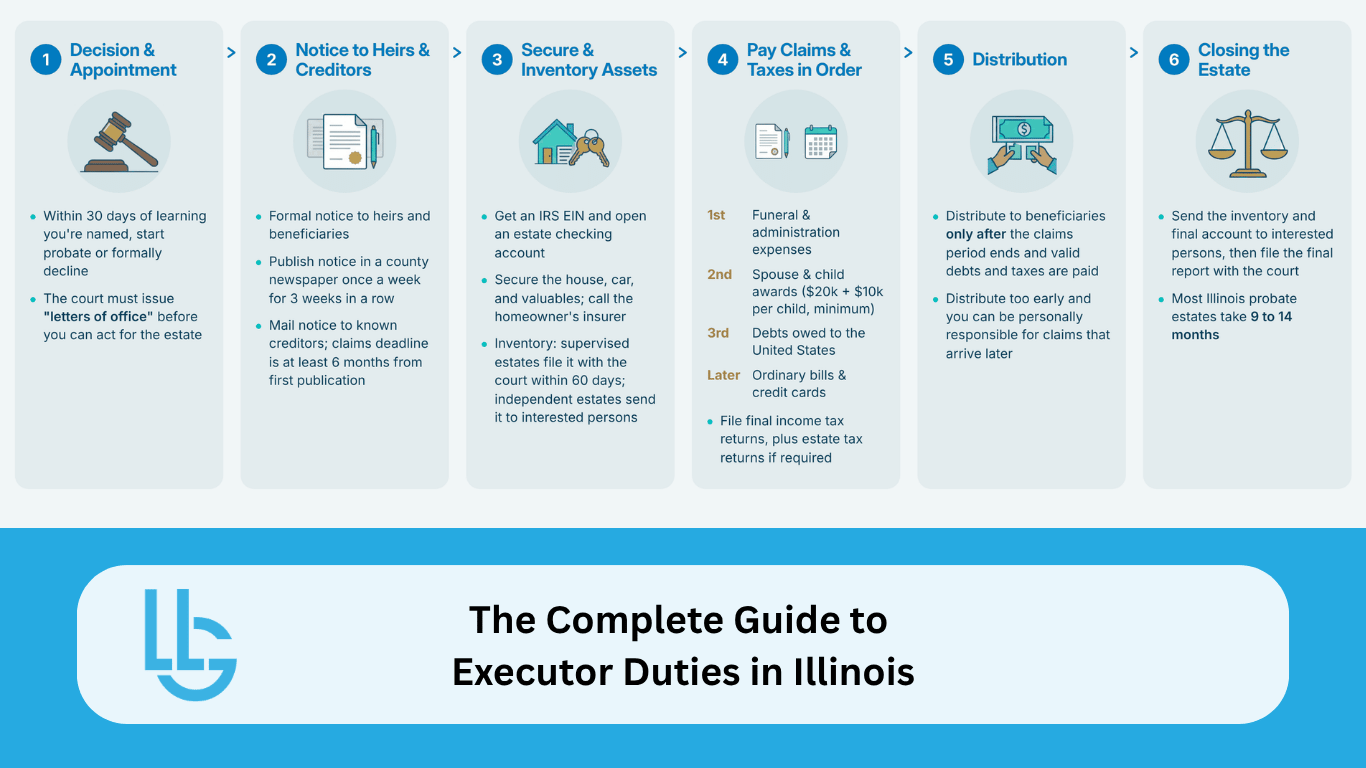
No. Being named in a will doesn’t obligate you to serve. You can’t simply ignore it, though. Under 755 ILCS 5/6-3, within 30 days of learning you’ve been named, you must either start the probate proceeding or formally decline to act. Whoever has the original will must also file it with the clerk of the circuit court in the county where the person lived, which for most of our clients means the DuPage County courthouse in Wheaton or the Cook County Probate Division at the Daley Center.
Who’s allowed to serve? Under 755 ILCS 5/6-13, an executor must be at least 18, a U.S. resident, of sound mind, not an adjudicated person with a disability, and not currently incarcerated. A prior felony conviction disqualifies someone unless the will specifically acknowledges it. You don’t have to live in Illinois, though the court can require an out-of-state executor to post a bond even if the will waives one.
If you’re on the fence, have that conversation before the 30 days run out, not after.
Getting Appointed: Why the Will Alone Isn’t Enough
Your authority doesn’t come from the will. It comes from the court. Once the judge admits the will, the court issues “letters of office.” That is the document that banks, brokerages, title companies, and the Secretary of State will ask to see. Until you have the letters of offce, you can’t act on behalf of the estate.
Most Illinois estates move forward under independent administration, which lets the executor handle the estate without asking the judge’s permission at every step. Supervised administration keeps the court involved throughout and tends to show up when there’s family conflict or when the will requires it. Under either path, every statutory duty still applies, and any interested person can ask the court to step in.
Unless the will waives it, you’ll also need a surety bond. Think of it as insurance that protects the beneficiaries if the estate’s money is mishandled.
Notice: Who You Have to Tell, and When
This is the step that small, simple-looking estates most often get wrong.
Heirs and beneficiaries must receive formal notice that the will was admitted and who was appointed. Creditors get two kinds of notice under 755 ILCS 5/18-3:
- A published notice, once a week for three successive weeks, in a newspaper published in the county where the estate is being handled
- A mailed or delivered notice to every creditor whose name and address you know or could reasonably find
- A claims deadline of at least six months from the first publication, or three months from mailing, whichever comes later
Creditors who miss that deadline are barred. Without proper notice, though, the estate stays exposed to claims for up to two years after the date of death.
We’ve had clients assume the funeral home’s obituary took care of this. It doesn’t. An obituary isn’t a claims notice, and skipping the real one can keep an estate open to surprise bills long after everyone thought it was finished.
Finding, Securing, and Valuing Everything
Your next job is to figure out what the estate actually owns and protect it while probate runs. In practice, that means:
- Getting an employer identification number from the IRS and opening an estate checking account, so estate money never mixes with yours
- Securing the house, the car, jewelry, firearms, and anything else of value
- Calling the homeowner’s insurer right away, since many policies limit coverage once a home sits vacant
- Redirecting mail, which is often how you find accounts and bills nobody knew about
- Getting date-of-death values for real estate, investment accounts, and business interests
Illinois requires an inventory of the estate’s assets. Under 755 ILCS 5/14-1, a supervised executor files it with the court within 60 days after letters issue. An independent executor doesn’t file it with the court but must mail or deliver a copy to the interested persons.
Not everything belongs in that inventory. Life insurance, retirement accounts with named beneficiaries, joint accounts with survivorship rights, and a home transferred by a transfer on death instrument pass outside probate entirely. Sorting probate assets from non-probate assets early saves a lot of confusion later.
Paying Bills in the Right Order
Here’s a rule that surprises people: you don’t pay the estate’s bills as they arrive. Illinois ranks claims by class, starting with funeral and burial costs and the expenses of administering the estate, then the surviving spouse’s and children’s awards, then debts owed to the United States, with ordinary bills like credit cards and most medical balances further down the line.
The spouse’s award alone can be significant. Under 755 ILCS 5/15-1, a surviving spouse is entitled to at least $20,000, plus at least $10,000 for each minor or dependent child living with them, for support during the nine months after the death.
Why does the order matter? If the estate can’t cover everything and you’ve already paid a lower-priority creditor, you may have to make up the difference yourself.
Taxes deserve their own line on your list:
- The decedent’s final federal and Illinois income tax returns
- An estate income tax return (Form 1041) if the estate earns $600 or more in a year
- An Illinois estate tax return if the estate exceeds the $4 million Illinois exemption, which is far lower than the 2026 federal exemption of $15 million
Illinois doesn’t let spouses share their exemptions the way federal law does, which catches more Naperville families than you’d expect.
Distribution and Closing the Estate
Only after the claims period has run, the valid debts are paid, and the taxes are handled should the beneficiaries receive their shares. Distribute too early and you’re the one the court looks to if a valid claim shows up later.
We’ve seen executors write checks to their siblings in month three to keep the peace, only to have a hospital claim arrive in month five. The money was gone, and the executor was on the hook.
To close an independent estate, you’ll send the inventory and a final account to the interested persons, get their approval or give them notice, and file a final report with the court. Most Illinois probate estates take somewhere between nine and fourteen months, and our guide to how long probate takes in Illinois walks through what speeds that up or slows it down.
Your Pay, and Your Personal Exposure
Illinois executors are entitled to reasonable compensation for their time, along with reimbursement of legitimate expenses. Many family members waive the fee, and that’s fine, but it’s your call.
What you can’t do is treat the estate as your own. You owe the beneficiaries a duty of loyalty and care, which means no mixing funds, no borrowing from the estate, and no buying estate property at a family discount without the proper approvals. If you’re handling the family home, our guide to executor property sales covers that process in detail.
When an executor falls short, a beneficiary can ask the court to order an accounting, remove the executor, or make them repay losses out of pocket under 755 ILCS 5/23-2. Most executor trouble isn’t dishonesty. It’s an honest mistake made without guidance.
Questions We Hear From Executors
Do I have to pay the estate’s debts out of my own pocket?
No. The estate’s debts are paid from the estate’s assets, not yours. Your personal exposure comes from how you handle the estate, such as paying creditors out of order or distributing to beneficiaries before claims are resolved.
Can I serve as executor if I live outside Illinois?
Yes, as long as you’re a U.S. resident and otherwise qualified. The court may require you to post a bond even if the will waives it, and it helps to have an Illinois attorney handling the local filings.
Does every estate have to go through probate?
No. If most assets pass by beneficiary designation, joint ownership, a trust, or a TODI, there may be little or nothing left to probate. Estates with no real estate and probate assets of $150,000 or less may qualify for the Illinois small estate affidavit instead.
Can I sell the house before probate is finished?
Often, yes. Once you have letters of office, an independent executor can typically sell real estate without a separate court order, though the sale still has to be in the estate’s best interest and properly documented.
What if I start and realize I can’t keep going?
You can resign, but you’ll need the court’s approval and you’ll have to account for everything you’ve done up to that point. It’s far easier to get help early than to hand off a half-administered estate.
You Don’t Have to Carry This Alone
Most executors are grieving while they’re doing this work, and the Probate Act doesn’t slow down for that. At Long Law Group, we guide executors and administrators through every stage of Illinois probate, from the first filing to the final report.
The job comes with a title, a deadline, and your name on every filing. It shouldn’t come with guesswork.
Named as an Executor? Let’s Talk First.
Contact Long Law Group today for a consultation about your role and your next steps.
Phone: 312-344-3644
Email: Contact@JLongLaw.com
Additional Probate and Estate Administration Articles

Informational/Promotional Content: The content of this website is informational and/or promotional and not for the purpose of providing legal advice. To obtain legal advice, please contact Long Law Group or your attorney with respect to any particular issue or problem. No Attorney-Client Relationship Created by Use of this Website: Neither your receipt of information from this website nor your use of this website to contact Long Law Group creates an attorney-client relationship between you and Long Law Group or any of its employees. As a matter of policy, Long Law Group does not accept a new client without first investigating for possible conflicts of interest and obtaining a signed engagement letter. Accordingly, you should not use this website to provide confidential information about a legal matter of yours.