Holiday Travel Accidents in Illinois: Know Your Rights
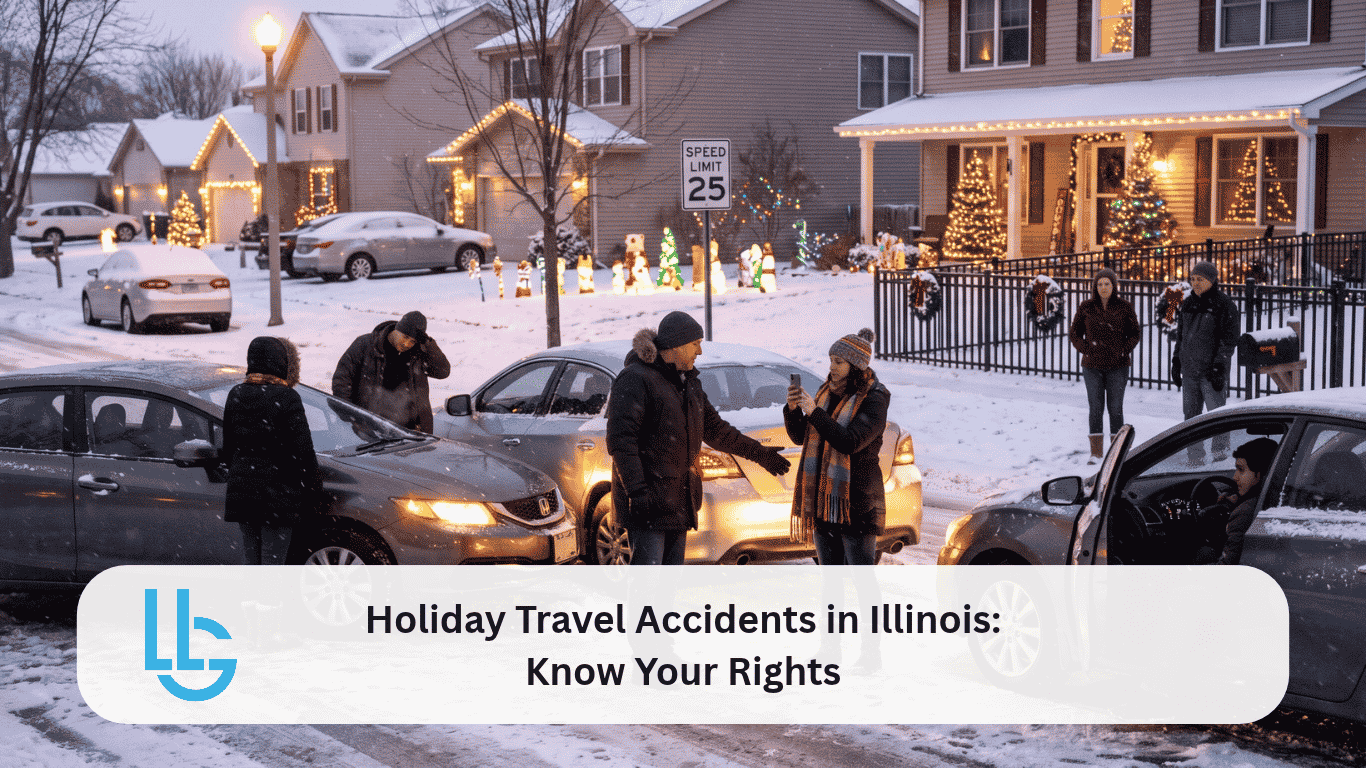
By Long Law Group — Illinois Personal Injury Attorneys proudly serving families throughout Naperville, Warrenville, DuPage County, Cook County, Will County, Kane County, and the greater Chicagoland area.
Thanksgiving falls on November 26 this year, and if you’re like most of the families we know, the plan involves a car. A drive down I-55 to see your sister in Bloomington. A run up to Milwaukee for the long weekend. Or the ten-minute trip to your in-laws’ house that somehow takes forty because everyone else in the western suburbs is on the same road at the same time.
The numbers reflect that. During the 2024 Thanksgiving holiday period, IDOT reported 2,784 crashes on Illinois roads and 15 people killed, and the state runs stepped-up seat belt and DUI patrols every year for exactly that reason.
If a crash becomes part of your holiday this year, here’s what Illinois law says, what changes when you’re far from home, and what to do in the first hour.
Why Holiday Crashes Are Different
Most of the car accidents we handle involve a familiar road and a routine trip. Holiday crashes tend to involve the opposite:
- Impaired drivers: the night before Thanksgiving is one of the heaviest bar nights of the year, and the pattern carries through the weekend
- Fatigue: long drives after a big meal, often late in the day
- Weather: late November in northern Illinois can bring the first real ice of the season, and drivers who haven’t adjusted yet
- Full cars: more passengers means more injured people from a single crash, often from the same family
- Unfamiliar roads: out-of-state drivers, rental cars, and rideshares on both ends of the trip
The First Hour: What to Do at the Scene
Even on a holiday, the basics don’t change. If you’re able to:
- Call 911 and ask for police. On a busy holiday they may be slow to arrive; wait anyway. A police report is the single most useful document in your claim.
- Get medical care that day, even if you feel fine. Adrenaline hides injuries, and a gap in treatment is the first thing an insurer will point to.
- Photograph everything: both cars, the road, the weather, skid marks, and the other driver’s license and insurance card.
- Get names and phone numbers for witnesses, including your own passengers.
- Say as little as possible to the other driver about fault, and nothing at all to the other driver’s insurance company until you’ve talked to a lawyer.
Illinois also requires a written crash report to the Illinois Department of Transportation within 10 days when anyone is injured or killed, or when property damage exceeds $1,500, if police didn’t file one (625 ILCS 5/11-406). Our step-by-step car accident guide covers the full checklist.
Crashed Outside Illinois? Here’s Which Law Applies
This is the question that makes holiday crashes complicated. Say you live in Naperville, you’re rear-ended on I-65 in Indiana, and the other driver is from Ohio. Whose rules apply?
The short answer: usually the state where the crash happened. The Illinois Supreme Court held in Townsend v. Sears, Roebuck & Co. (2007) that the law of the place of injury presumptively governs a personal injury claim unless another state has a more significant relationship to the accident and the people involved. When everyone is from somewhere different, that presumption usually holds.
That matters for a few reasons:
- Deadlines differ. Illinois gives you two years to file a personal injury lawsuit (735 ILCS 5/13-202). Some neighboring states give you less time, and some give you more. Don’t assume the Illinois clock applies.
- Fault rules differ. Illinois cuts off recovery at 51% fault; other states draw the line in different places, and a few bar recovery entirely if you were even slightly at fault.
What doesn’t change is your own insurance. An Illinois auto policy travels with you. Your medical payments coverage, your collision coverage, and your uninsured and underinsured motorist coverage all apply to a crash in Indiana or Wisconsin exactly as they would at home.
We’ve had clients wait six months after an out-of-state crash to call anyone because they assumed they’d need a lawyer in that state. Sometimes they do, and we’ll say so. But the first call should still be to someone who knows your policy and your rights as an Illinois resident.
When a Drunk Driver Is Involved
The Wednesday night before Thanksgiving has earned a nickname for a reason. If you’re hit by an impaired driver, Illinois gives you an avenue most states don’t.
Under the Illinois Dram Shop Act, a bar, restaurant, or other licensed seller that served alcohol to the person who caused your injury can be held liable, without proof that the business was careless. Recovery is capped, and the cap is adjusted each year. For judgments and settlements on or after January 20, 2026, the limit is $90,411.55 per person for injury or property damage, and $110,503 for loss of support or loss of society.
Two things to know. First, the deadline is short: one year from the date of injury, not two. Second, Illinois generally does not hold social hosts liable. If the driver got drunk at a private Thanksgiving dinner rather than at a bar, the host usually isn’t on the hook, with a narrow exception involving minors.
The drunk driver’s own policy remains the primary source of recovery, and a jury can award punitive damages against a driver whose conduct was reckless enough.
Passengers, Rental Cars, and Rideshares
Passengers. If you were hurt as a passenger, you almost always have a claim, even if the driver was your spouse or your brother-in-law. The claim is paid by the at-fault driver’s insurance, not by the driver personally, and families sometimes hesitate for no good reason.
Rental cars. If you rented for the trip, your own auto policy typically follows you into the rental, and many credit cards add collision coverage. Read what you signed at the counter before you assume the rental company’s coverage applies.
Rideshares. If you’re hurt in an Uber or Lyft, or hit by one, Illinois law requires the company to carry $1 million in liability coverage while a passenger is in the car (625 ILCS 57/10). Coverage is lower when the driver is logged in but waiting for a ride, and the driver’s personal policy may exclude commercial use entirely. Screenshot the trip details before the app clears them.
Illinois Deadlines and Fault Rules in Plain Terms
For a crash that happened in Illinois:
- Two years to file a personal injury lawsuit, and generally the same for a wrongful death claim
- One year if the at-fault driver was working for a city, county, or other local government, such as a snowplow operator (745 ILCS 10/8-101)
- One year for a Dram Shop claim against a bar, restaurant, or other licensed seller
- Modified comparative negligence: your recovery is reduced by your share of fault and eliminated at 51% (735 ILCS 5/2-1116). Our comparative negligence guide explains how insurers use this against you.
- Minimum coverage is thin: Illinois requires only $25,000 per person and $50,000 per crash in bodily injury liability. A serious injury exceeds that fast, which is where your own underinsured motorist coverage comes in.
One more rule worth knowing before you get on the road. Scott’s Law requires you to slow down and, where possible, move over for any stopped vehicle with its hazard lights on, not just police cars and ambulances. Holiday weekends are full of stranded cars on the shoulder.
Questions We Hear From Families After a Holiday Crash
The other driver was from out of state and already went home. What now?
Their insurance company is still responsible, and it doesn’t matter where they live. Get the police report, give us the insurance information from the scene, and we’ll handle contact with the carrier.
Should I use my own insurance or theirs?
Often both. Your medical payments coverage can pay bills right away while the liability claim takes shape, and your collision coverage can get your car fixed faster, with your insurer recovering from the other carrier later. In a crash that wasn’t your fault, using your own coverage generally shouldn’t affect your rates.
Is it too late if I didn’t see a doctor until after the holiday weekend?
No, but go now. A few days’ gap is explainable; a few weeks’ gap is harder. Tell the provider you were in a car crash so it’s documented.
Get Home, Then Get Help
Most holiday crashes end with everyone shaken but okay. When they don’t, the days after are confusing enough without trying to sort out which state’s rules apply or whether a bar can be held responsible. At Long Law Group, we handle personal injury claims for families across the western suburbs, including crashes that happened a long way from home.
Drive carefully, and if you need us, we’ll be here when you get back.
Hurt in a Holiday Crash? Call Us Before You Call Their Insurer.
Contact Long Law Group today for a consultation about your rights after a holiday travel accident.
Phone: 312-344-3644
Email: Contact@JLongLaw.com

Informational/Promotional Content: The content of this website is informational and/or promotional and not for the purpose of providing legal advice. To obtain legal advice, please contact Long Law Group or your attorney with respect to any particular issue or problem. No Attorney-Client Relationship Created by Use of this Website: Neither your receipt of information from this website nor your use of this website to contact Long Law Group creates an attorney-client relationship between you and Long Law Group or any of its employees. As a matter of policy, Long Law Group does not accept a new client without first investigating for possible conflicts of interest and obtaining a signed engagement letter. Accordingly, you should not use this website to provide confidential information about a legal matter of yours.