Pedestrian and Bicycle Accidents: Illinois Laws and Your Rights
By Long Law Group — Illinois Personal Injury Attorneys proudly serving families throughout Naperville, Warrenville, DuPage County, Cook County, Will County, Kane County, and the greater Chicagoland area.
Fall changes how Naperville moves. Kids are walking to school along Washington Street, cyclists are squeezing in the last good rides on the Illinois Prairie Path and the DuPage River Trail, and on November 1, clocks fall back and the evening commute turns dark before 5 p.m.
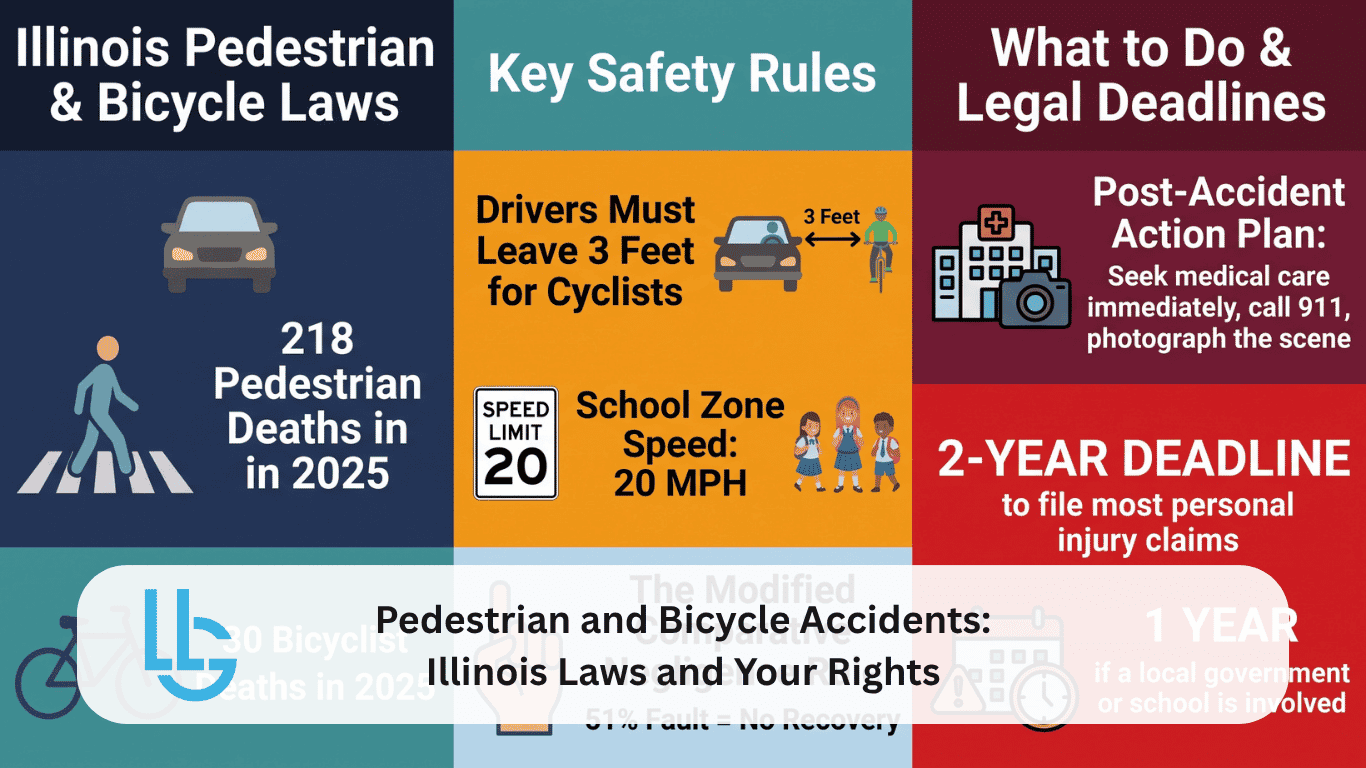
That’s a bad combination for anyone on foot or on a bike. Preliminary state data reported by the Daily Herald put Illinois pedestrian deaths at 218 in 2025, up from 195 in 2022, even as overall traffic deaths fell. Ride Illinois counted 30 bicyclists killed on Illinois roads in the same year.
If you or someone in your family was hit while walking or riding, here’s what Illinois law says about who had the right of way, and what you can do right now to protect your claim.
What Illinois Law Requires of Drivers
Illinois puts real obligations on drivers when people on foot or on a bike are nearby. Under the Illinois Vehicle Code:
- Where there’s no traffic signal, drivers must stop, not just slow down, for a pedestrian in a crosswalk on their half of the road or approaching closely from the other half (625 ILCS 5/11-1002)
- A driver can’t pass another vehicle that’s stopped at a crosswalk to let someone cross
- Every driver must use due care to avoid hitting any pedestrian or bicyclist, crosswalk or not
- When passing a cyclist, drivers have to leave at least three feet and keep that distance until they’re safely past
- Nobody may open a car door into traffic unless it’s reasonably safe to do so, which is the rule behind “dooring” claims
- School zone speed drops to 20 mph on school days when children are present
When a driver breaks one of these rules and someone gets hurt, the violation becomes powerful evidence of negligence.
And What It Expects of You
Pedestrians and cyclists have duties too, and insurers know every one of them.
A pedestrian can’t suddenly step off the curb into the path of a car that’s too close to stop. Cyclists have the same rights and duties as drivers, which means obeying signals and signs, and after dark, riding with a white front light visible from 500 feet and a red rear reflector.
E-bikes are part of this picture now. Since January 1, 2026, low-speed e-bikes fall within Illinois’ legal definition of a bicycle. A new law signed in August, Public Act 104-0854, takes effect January 1, 2027, keeping e-bikes off sidewalks, setting minimum rider ages, and requiring a license and insurance for the fastest models.
Why does any of this matter if the driver clearly caused the crash? Because Illinois uses modified comparative negligence. If you’re found partly at fault, your recovery shrinks by that percentage, and at 51% you recover nothing. We cover how that works in our guide to comparative negligence in Illinois injury cases.
How Insurers Try to Shift the Blame
The driver’s insurance company rarely argues that its driver was careful. It argues that you weren’t. You’ll hear versions of the same few lines: you weren’t in the crosswalk, you came out of nowhere, you were wearing dark clothes, you didn’t have a light.
We’ve seen adjusters build an entire fault argument around a single detail like a dark jacket at dusk. That argument has limits. A driver’s duty of due care doesn’t disappear because a pedestrian was hard to see, and the evidence often shows a driver who was speeding, distracted, or turning without looking.
Every percentage point they move onto you saves them money. That’s the whole strategy.
The Coverage Most People Don’t Know They Have
What happens if the driver had no insurance, or drove away?
Many people assume their own auto policy only helps when they’re in their car. In Illinois, that’s not the case. In Galarza v. Direct Auto Insurance Co. (2023), the Illinois Supreme Court held that an insurer can’t limit uninsured motorist coverage to people inside an insured vehicle. A 14-year-old hit while riding his bike was covered under his father’s policy.
In practice, if you or a household family member has auto insurance, that policy’s uninsured and underinsured motorist coverage may protect you as a pedestrian or cyclist, including in a hit-and-run. It’s one of the first things we check.
What to Do After You’ve Been Hit
If you’re able to act at the scene or in the days after, these steps protect both your health and your claim:
- Call 911 and get a police report, even if the driver wants to “handle it privately”
- Get medical care right away, since adrenaline can hide head, neck, and internal injuries
- Photograph the scene, the vehicle, the crosswalk or bike lane, your injuries, and the lighting conditions
- Collect the driver’s information and contact details for any witnesses
- Ask nearby businesses and homeowners about doorbell and security cameras before the footage is overwritten
- Keep your damaged bike, helmet, clothing, and shoes exactly as they are
- Don’t give a recorded statement to the driver’s insurer until you’ve talked with an attorney
Deadlines You Can’t Afford to Miss
Most Illinois personal injury claims must be filed within two years of the crash. If a village, city, park district, or school district is involved, such as a public vehicle or a dangerous public road or sidewalk, the deadline is generally one year under the Local Governmental and Governmental Employees Tort Immunity Act.
Claims involving children and fatal crashes follow their own rules. If a family member died, our article on Illinois wrongful death and probate explains how those claims are brought.
Questions We Hear From Injured Pedestrians and Cyclists
What if I wasn’t in a crosswalk when I was hit?
You may still have a claim. Crossing outside a crosswalk can shift some fault onto you, but drivers still owe everyone on the road a duty of due care. Under comparative negligence, partial fault reduces your recovery; it doesn’t automatically end it.
Does it matter that I wasn’t wearing a bike helmet?
Illinois has no statewide bicycle helmet law, so riding without one isn’t a traffic violation. An insurer may still argue it made a head injury worse. That’s an argument to answer, not a reason to give up on your claim.
The driver took off. Do I have any options?
Yes. Report the crash to police right away, then look at your own auto policy and any household member’s policy. Uninsured motorist coverage can apply to hit-and-run crashes, even when you were on foot or on a bike.
My child was hit near school. What should we do first?
Get your child checked by a doctor, file a police report, and document the scene and any school zone signs. Then talk to an attorney quickly, especially if a school district or village is involved, because those deadlines can be much shorter.
Walking and Riding Shouldn’t Cost You Your Health
A pedestrian or bicycle crash happens in seconds, and the recovery can take months. Medical bills arrive, work gets missed, and an adjuster starts building a story about what you did wrong.
At Long Law Group, we represent injured pedestrians and cyclists, and we know how to answer the blame-shifting before it sticks. If you were hit, talk to us before you talk to their insurance company.
Hit While Walking or Riding? We Can Help.
Contact Long Law Group today for a consultation.
Phone: 312-344-3644
Email: Contact@JLongLaw.com
Additional Personal Injury Articles
-
- Motorcycle Accident Claims in Illinois: What Makes Them Different
- What to Do After a Car Accident in Illinois: A 2026 Step-by-Step Guide
- Top 10 Questions About Personal Injury Claims Illinois
- Swimming Pool Accidents and Liability in Illinois
- Workers’ Comp vs. Personal Injury in Illinois: Which Claim Should You File?

Informational/Promotional Content: The content of this website is informational and/or promotional and not for the purpose of providing legal advice. To obtain legal advice, please contact Long Law Group or your attorney with respect to any particular issue or problem. No Attorney-Client Relationship Created by Use of this Website: Neither your receipt of information from this website nor your use of this website to contact Long Law Group creates an attorney-client relationship between you and Long Law Group or any of its employees. As a matter of policy, Long Law Group does not accept a new client without first investigating for possible conflicts of interest and obtaining a signed engagement letter. Accordingly, you should not use this website to provide confidential information about a legal matter of yours.